



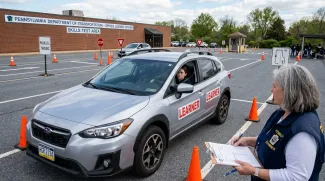


The Alabama driver license test — officially administered by the Alabama Law Enforcement Agency (ALEA) — is a written knowledge exam every first-time applicant must pass before obtaining a learner permit or full driver's license. This page provides a comprehensive Alabama DMV practice test with 50 questions drawn from the official Alabama Driver Manual, covering road signs, traffic laws, right-of-way rules, speed limits, DUI regulations, and safe driving techniques. Whether you are a teen studying for your Alabama learner permit test or an adult preparing for license reinstatement, our free practice quiz mirrors the real ALEA knowledge exam format so you can study confidently. All questions are based on current Alabama traffic laws 2025 and reflect the latest updates to the state's graduated licensing program (GDL) for drivers under 18. Read through the study guide below, take the interactive quiz, and use the tips in this article to pass the Alabama driver license exam on your first attempt.
Driver License Test Alabama | 50 Questions
Alabama Driver License Test
Quiz preview: 3 sample questions.
- What does a red octagon sign indicate
- What does a yellow pennant sign mean
- What shape is a yield sign
The interactive quiz above includes 50 questions that closely mirror the official Alabama driver license knowledge test. Questions are drawn from all major categories tested by ALEA: traffic signs, pavement markings, right-of-way rules, speed limits, alcohol and drug laws, sharing the road, and vehicle safety. Each question is multiple-choice with four answer options, just like the real exam. After submitting your answers you will receive an instant score and see which questions you missed — making it easy to focus your review on weak areas.
The Alabama knowledge test requires a minimum passing score of 80%, which means you must answer at least 32 out of 40 questions correctly on the official exam (ALEA administers a 40-question version at driver license offices; our expanded 50-question version provides additional practice coverage). Repeat the quiz as many times as you like — questions are pulled randomly from our full Alabama question bank to keep every session fresh.
About the Real Alabama Knowledge Exam
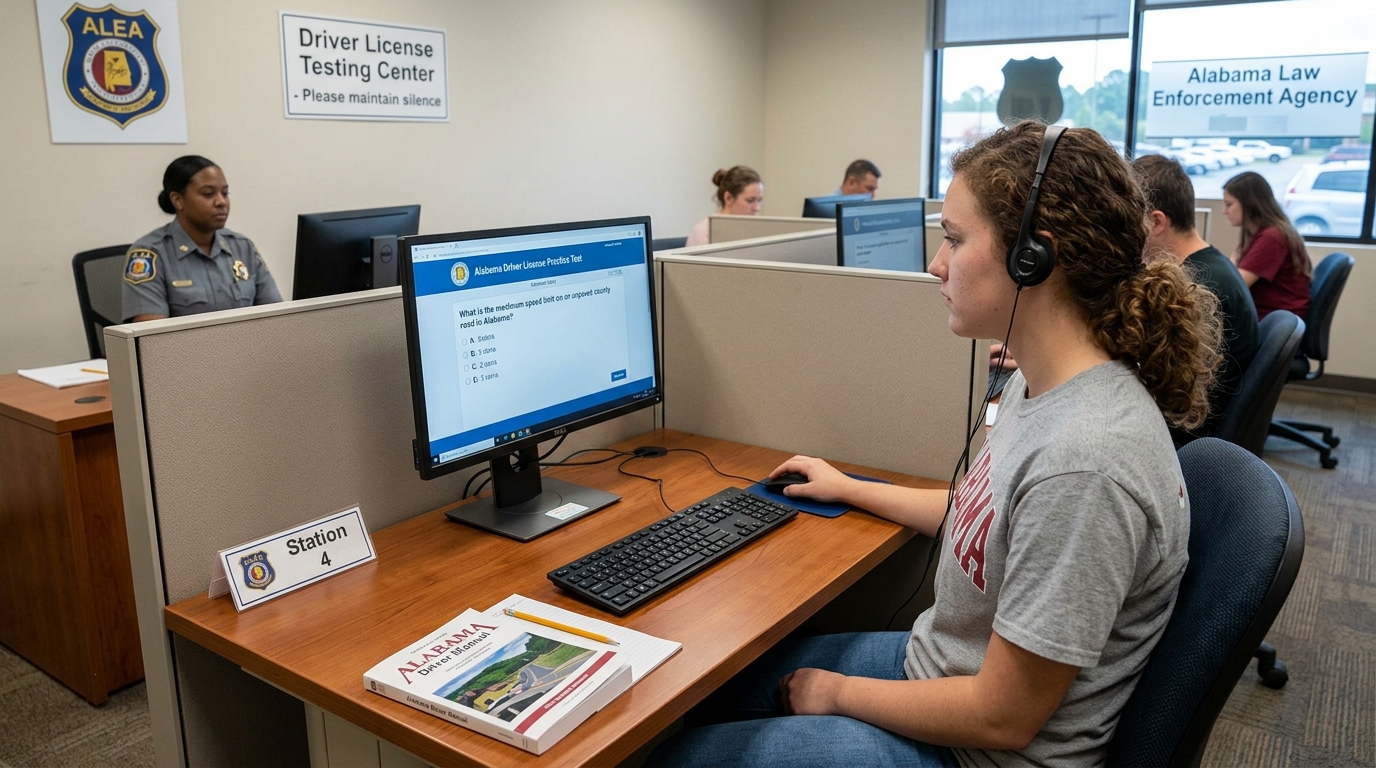
The real Alabama driver license knowledge test is administered on a computer at any ALEA Driver License Office across the state. The exam consists of 40 multiple-choice questions selected from a question bank developed directly from the Alabama Driver Manual. Test-takers must achieve a score of at least 80 percent — correctly answering a minimum of 32 questions — to pass and qualify for a learner permit or driver's license. There is no official per-question time limit, though most candidates complete the exam in 20 to 30 minutes.
The exam is divided into two main parts: a road sign recognition section and a traffic laws and safe driving section. In the road signs portion, you will be shown color images of regulatory, warning, and informational signs and asked to identify their meaning — no text labels are provided, so you must memorize sign shapes and colors. The laws section covers topics such as right-of-way at intersections, Alabama speed limits by roadway type, following distance, passing rules, DUI/DWI penalties, and Alabama's mandatory seat belt law. First-time applicants under age 18 are tested under the Graduated Driver License rules and must also demonstrate knowledge of the nighttime driving curfew and passenger restrictions.
How Many Times Can You Retake the Test?
Alabama does not limit the total number of retake attempts, but you must wait at least one day between failed attempts. There is a $5 retest fee for each retake after the first failure. Most ALEA offices recommend scheduling your retake appointment at least a week after a failure to allow adequate study time.
Who Must Take the Knowledge Test?
- All first-time Alabama driver's license applicants, regardless of age
- Applicants converting an out-of-state license from certain states (ALEA evaluates on a case-by-case basis)
- Drivers seeking license reinstatement after suspension or revocation
- Teen applicants applying for a Learner License under the GDL program
- Drivers over 65 renewing a license after a lapse of more than four years
Alabama Road Signs You Must Know
Road sign recognition is one of the most heavily tested areas of the Alabama driver license exam, and many first-time test-takers underestimate how specific the questions can be. Alabama follows the national Manual on Uniform Traffic Control Devices (MUTCD), meaning all signs conform to federal shape and color standards — but understanding why each sign looks the way it does is key to memorizing them quickly and accurately.
Regulatory Signs — Red & White
Regulatory signs carry the force of law. Ignoring them can result in a traffic citation or, worse, a collision. These signs are typically white with red or black lettering and include the iconic STOP (red octagon), YIELD (red-and-white triangle), speed limit signs, NO TURN signs, and DO NOT ENTER. On the Alabama knowledge test, you may be shown the sign's image and asked to choose the correct meaning from four options — or given a driving scenario and asked which sign applies.
- STOP sign — Come to a complete stop; proceed only when safe and after yielding to all traffic
- YIELD sign — Slow down and give right-of-way; stop only if necessary
- Speed Limit signs — Display the maximum legal speed for normal conditions
- NO U-TURN — U-turns are prohibited at this location
- ONE WAY — Traffic moves only in the direction of the arrow
- DO NOT ENTER / WRONG WAY — You are attempting to enter a road going against traffic
Warning Signs — Yellow Diamond
Warning signs alert you to upcoming hazards or changes in road conditions. They are yellow (or orange in construction zones) with black symbols or text, and are almost always diamond-shaped. Common examples include curve warnings, hill warnings, pedestrian crossing signs, school zone signs, and deer crossing signs. On the exam, pay close attention to the shape of the sign — the diamond shape alone tells you it is a warning, even before you read the symbol.
- Slippery When Wet — Reduce speed and avoid sudden braking on this surface
- Pedestrian Crossing — Watch for pedestrians crossing the roadway
- School Zone / School Crossing — Reduce speed to 15–25 mph; watch for children
- Railroad Crossing (RR crossbuck) — Be prepared to stop for trains
- Winding Road — Series of curves ahead; adjust speed accordingly
Guide & Informational Signs — Green & Blue
Green signs provide highway and route guidance (distances, exit numbers, destinations), while blue signs indicate services such as hospitals, fuel, food, and lodging. Brown signs mark recreational areas, national parks, and points of interest. These are less heavily tested on the Alabama exam but still appear, especially regarding interstate highway numbering conventions (even numbers = east–west routes; odd numbers = north–south routes).
Key Alabama Traffic Laws & Speed Limits
Alabama's traffic laws are codified in Title 32 of the Code of Alabama and summarized in the Alabama Driver Manual. The knowledge test will assess your understanding of speed limits, right-of-way rules, open-container laws, cell phone restrictions, and Alabama's mandatory seat belt and child safety seat laws. Below are the areas most frequently covered on the exam.
Alabama Speed Limits by Road Type
Unless otherwise posted, the following default speed limits apply in Alabama:
- Interstate highways: 70 mph for passenger vehicles (65 mph for trucks)
- Divided multi-lane highways: 65 mph
- Undivided rural highways: 55 mph
- Urban/suburban streets: 35 mph
- Residential streets: 25 mph (unless posted)
- School zones (when active): 15–25 mph depending on signage
Right-of-Way Rules
Right-of-way questions consistently appear on the Alabama driver test. The golden rule is: the law gives the right-of-way; it never guarantees it. At an uncontrolled intersection, the driver who arrives first has the right-of-way; if two vehicles arrive simultaneously, the driver on the left must yield to the driver on the right. When entering a roundabout, yield to all vehicles already in the circle. Emergency vehicles with lights and sirens activated always have the right-of-way — pull to the right edge of the road and stop.
Alabama Seat Belt & Cell Phone Laws
Alabama has a primary seat belt law for front-seat occupants, meaning law enforcement may stop and ticket you solely for not wearing a seat belt — no other violation is required. All children under age 6 must be secured in a federally approved child safety seat; children ages 6–14 must wear a seat belt regardless of seating position.
Alabama prohibits texting while driving for all drivers (first offense: $25 fine). Drivers with a learner permit or Graduated Driver License (under age 18) are prohibited from using any handheld device, including hands-free, while driving. Violations are primary offenses and points are assessed against the driving record.
Alabama DUI Laws
- Legal blood alcohol concentration (BAC) limit: 0.08% for drivers 21+
- BAC limit for commercial drivers: 0.04%
- BAC limit for drivers under 21: 0.02% (zero tolerance)
- Implied consent law: refusing a breathalyzer results in automatic license suspension
- First DUI conviction: up to 1 year in jail, fines up to $2,100, 90-day license suspension
Alabama Graduated Driver Licensing (GDL) Program
Alabama's Graduated Driver Licensing (GDL) program is a three-stage system designed to help teen drivers build skills progressively before receiving full driving privileges. If you are under 18, understanding the GDL rules is essential — they will be tested on your knowledge exam, and violations can delay your progress to the next licensing stage.
Stage 1 — Learner License (Age 15+)
The Learner License is issued after passing the written knowledge test and a vision screening. It allows supervised driving practice with a licensed driver age 21 or older in the front passenger seat at all times. You must hold the Learner License for a minimum of six months and complete at least 30 hours of supervised driving (including 10 hours at night) before progressing.
- No driving between midnight and 6 a.m. without a supervising adult
- No use of any wireless device (handheld or hands-free)
- All occupants must wear seat belts
Stage 2 — Restricted License (Age 16–17)
After completing Stage 1, drivers age 16 may apply for a Restricted License. This allows unsupervised driving, but with important restrictions designed to limit high-risk situations.
- Nighttime restriction: No unsupervised driving between midnight and 6 a.m.
- Passenger restriction: No more than one non-family passenger under age 21 during the first six months
- No wireless device use of any kind
- Must maintain a clean driving record to advance to full licensure
Stage 3 — Full License (Age 17+)
At age 17, after holding the Restricted License without violations, a driver may apply for a full unrestricted Alabama driver's license. All GDL restrictions are lifted at this point, though the general Alabama traffic laws — including cell phone restrictions for all drivers and seat belt requirements — still apply.
Test Day Tips & What to Bring to the ALEA Office
Passing the Alabama driver license test is absolutely achievable with the right preparation. Beyond studying the material, knowing what to expect on test day — and arriving fully prepared with the correct documents — will save you time and stress.
Documents Required at the ALEA Office
- Proof of identity: U.S. birth certificate, valid U.S. passport, or other REAL ID-compliant document
- Proof of Social Security Number: Social Security card, W-2 form, or official SSN letter
- Proof of Alabama residency: Two documents such as utility bills, bank statements, or lease agreements showing your name and Alabama address
- Proof of legal presence: For non-U.S. citizens, valid immigration documents are required
- Application fee: $36.25 for a standard non-commercial driver's license (cash or card accepted at most offices)
Last-Minute Study Strategies
The night before your test, focus on road sign flashcards rather than re-reading the entire manual. Road signs are highly visual — reviewing images of signs alongside their meanings is far more effective than reading descriptions alone. Pay special attention to signs that look similar but have different meanings, such as the Yield sign versus the No Passing Zone pennant-shaped sign.
On the morning of your test, avoid cramming new material. Instead, briefly review your weakest areas, eat a good meal, and arrive at the ALEA office at least 15 minutes early. The computer-based exam is self-paced — read each question carefully before answering. If you are unsure of an answer, use the process of elimination: cross out options you know are wrong to improve your odds on the remaining choices.
After You Pass — Next Steps
- Your Learner Permit is printed on-site at the ALEA office immediately after passing
- Schedule your behind-the-wheel driving test with a licensed Alabama driving instructor or through ALEA
- Complete the minimum supervised driving hours required for your age group
- Return to the ALEA office for your road skills test when you are ready
- Once you pass the road skills test, your full driver's license card will be mailed within 30 days